
The Lazarus Pulse: Classified Resurrection Frequency (1987)
Updated: Aug 31
BELIEVE IT OR NOT:
In 1987, deep inside a top-secret Soviet military complex known as Facility D12, a group of bioengineers, physicists, and military neurologists achieved what the world still refuses to believe: the temporary revival of the dead.
The project, code-named Necrosignal, was designed to study the post-life frequency gap: the exact moment when the human biofield collapses after death. Using harmonic pulse frequencies between 18.2 Hz and 22.1 Hz, they reactivated dead tissue that had been clinically lifeless for 6 hours and 47 minutes.
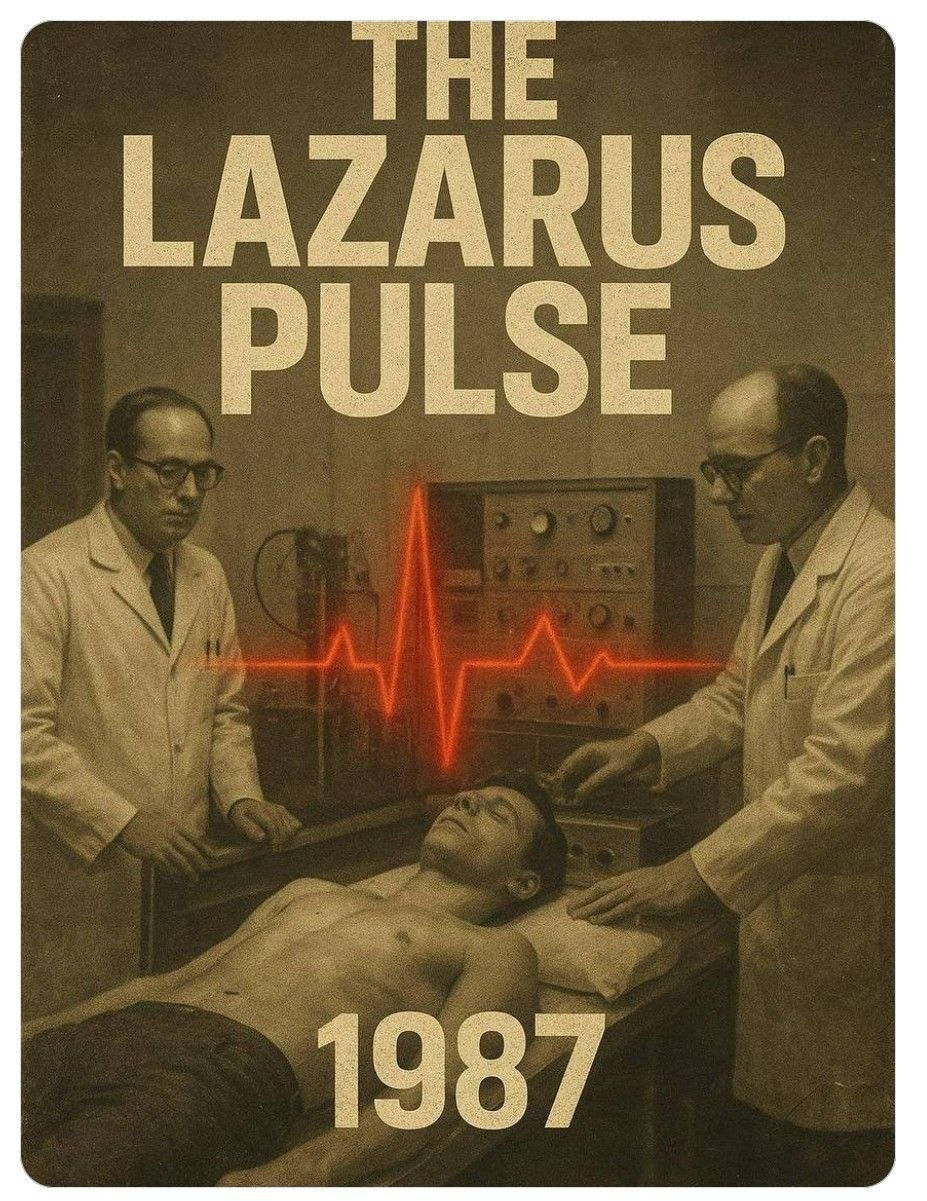
For six terrifying minutes, the impossible happened. Blood began to flow through veins that were dry. Neural circuits reignited like broken wires reconnected to power. The heart twitched. The lungs shook. The eyes moved. The dead responded. The room erupted in chaos. Two scientists collapsed. One screamed, “He’s seeing us.” Then came total blackout. The program was shut down within 14 minutes. All data was sealed under Kremlin Directive S 741 B. Files were erased. Lab equipment was destroyed. Seventeen researchers were reassigned to unknown locations.
Officially, it never existed. But decades later, a leaked archive from a defected researcher in Prague revealed a single, hand-written note inside a burned file: “Death is not the ending. It is a frequency imbalance. Realign the signal, and life returns.” This became known as the Lazarus Pulse: the first documented evidence that life and death are frequency states, not final conditions.
For a Therapy Appointment
To purchase home or professional equipment:
Contact Us: 561-662-8420
Email: AFWPBC@gmail.com


Comments